
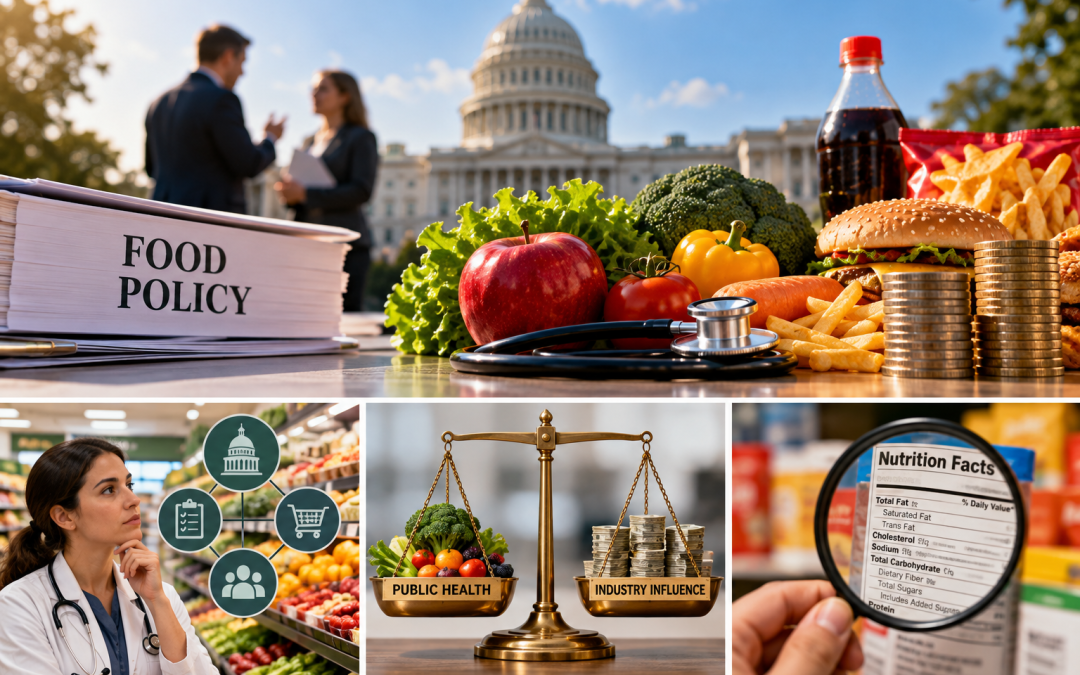
When healthcare professionals counsel patients about nutrition, the conversation often centers on individual choice. Patients may be encouraged to eat more vegetables, reduce added sugars, limit highly processed foods, and read nutrition labels. These recommendations matter, but food choices do not occur in isolation. Availability, price, marketing, and regulation are influenced by policies developed long before a patient enters a grocery store. This raises an important question: Who helps shape the policies that influence what Americans eat? Food industry lobbyists are part of that process.
Lobbying is a legal part of the political system. Agricultural producers, food manufacturers, healthcare organizations, professional associations, public health advocates, and consumer groups may all attempt to influence policymakers. The concern is not simply that food companies participate in policymaking. The larger public health question is whether differences in money, access, and organizational power allow commercial interests to outweigh health evidence.
Food Lobbying Extends Beyond Capitol Hill
The popular image of lobbying involves a representative meeting directly with an elected official. In reality, corporate political activity can take many forms. Mialon et al. (2015) identified six broad strategies used by the food industry to influence public health policy: information and messaging, financial incentives, constituency building, legal strategies, policy substitution, and efforts to fragment or destabilize opposition. Industry influence can therefore extend beyond direct lobbying to include funding research, developing partnerships, participating in advisory processes, promoting voluntary industry solutions, and shaping how nutrition issues are presented to policymakers and the public.
Recognizing these strategies does not mean assuming that every industry position is inappropriate. It does show why transparency is necessary when evaluating how food policy is developed. Cullerton et al. (2016) reviewed research on barriers and facilitators to nutrition policy change and found that political and public support strongly influenced whether policies were adopted. Industry pressure was also identified as an important barrier. Scientific evidence may inform nutrition policy, but it operates within a broader political environment that includes economic interests, institutional priorities, and public opinion.
Why Food Lobbying Matters in Healthcare
Lobbying may seem far removed from a healthcare professional treating hypertension, diabetes, obesity, or cardiovascular disease. The connection becomes clearer when the broader food environment is considered. Public policies influence food labeling, agricultural subsidies, nutrition assistance programs, school meals, advertising, food formulation, taxation, and regulation. These decisions affect which foods are affordable, widely available, and heavily promoted. By the time a patient chooses food from a grocery store, school cafeteria, restaurant, or convenience store, commercial and political decisions have already shaped the available options.
Chung et al. (2024) examined 23 years of lobbying data from OpenSecrets across several industries, including the ultra-processed food sector. Their analysis identified extensive lobbying activity by industries whose products or practices may affect public health. The authors argued that commercial lobbying should be considered part of the broader commercial determinants of health because political activity can influence health policy. Industry-funded research or industry-supported policies should not automatically be rejected. Funding source alone does not determine whether research is valid. However, financial relationships and potential conflicts of interest should be disclosed so healthcare professionals, researchers, policymakers, and the public can evaluate evidence in context.
Healthcare Professionals Have a Role
Healthcare professionals do not need to become professional lobbyists to understand food politics. They do benefit from recognizing that nutrition-related chronic disease develops within social, economic, political, and commercial systems. When evaluating dietary recommendations or food policies, healthcare professionals can ask useful questions. Who funded the supporting research? Which organizations participated in developing the recommendation? Were conflicts of interest disclosed? Were competing interpretations of the evidence considered? Who benefits economically, and who may experience unintended consequences? These questions are part of critical evaluation. Healthcare professionals also bring an important perspective to policy discussions because they see the consequences of chronic disease directly. Clinical experience, combined with high-quality evidence, can help keep the effects of food policy on patients and communities part of the conversation.
The Takeaway
Patients make individual food choices, but those choices occur within an environment shaped partly by political and commercial forces. Lobbying is one mechanism through which organizations influence that environment. Transparent lobbying and managed conflicts of interest help healthcare professionals interpret nutrition policy and patient choices in context.
References
Chung, H., Cullerton, K., & Lacy-Nichols, J. (2024). Mapping the lobbying footprint of harmful industries: 23 years of data from OpenSecrets. The Milbank Quarterly, 102(1), 212–232. https://doi.org/10.1111/1468-0009.12686
Cullerton, K., Donnet, T., Lee, A., & Gallegos, D. (2016). Playing the policy game: A review of the barriers to and enablers of nutrition policy change. Public Health Nutrition, 19(14), 2643–2653. https://doi.org/10.1017/S1368980016000677
Mialon, M., Swinburn, B., & Sacks, G. (2015). A proposed approach to systematically identify and monitor the corporate political activity of the food industry with respect to public health using publicly available information. Obesity Reviews, 16(7), 519–530. https://doi.org/10.1111/obr.12289
This article is presented for educational discussion in a Food Policies course. It does not provide individualized medical or dietary advice.